Introduction
As Bangladesh continues its journey toward rapid urbanization and industrial growth, environmental protection has become one of the most important challenges of our time. Residential buildings, hotels, hospitals, educational institutions, commercial complexes, and industrial facilities generate large volumes of wastewater every day. If this wastewater is discharged without proper treatment, it can severely contaminate rivers, canals, groundwater, and surrounding ecosystems.
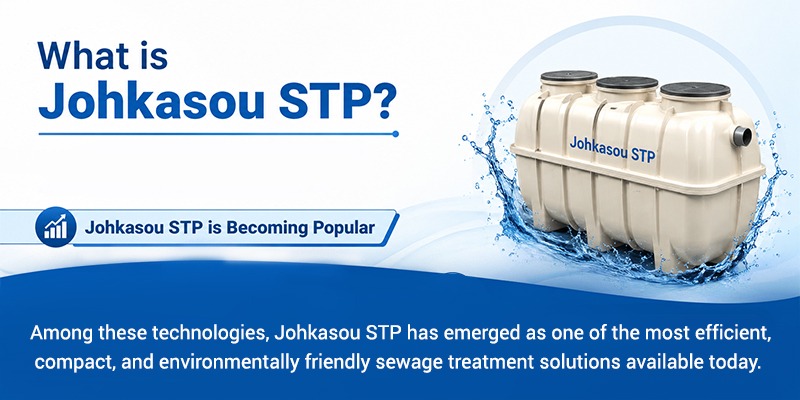
To address this challenge, modern wastewater treatment technologies are becoming increasingly essential. Among these technologies, Johkasou STP has emerged as one of the most efficient, compact, and environmentally friendly sewage treatment solutions available today. Originally developed in Japan, Johkasou STP has gained international recognition for its ability to provide high-quality wastewater treatment within a compact footprint. Unlike conventional sewage treatment plants that require extensive civil construction and large land areas, Johkasou systems are designed as integrated treatment units that combine multiple treatment processes within a single compact structure.
In recent years, the demand for Johkasou STP has increased significantly in Bangladesh due to stricter environmental regulations, limited land availability, and growing awareness regarding sustainable wastewater management.
This article provides a comprehensive overview of Johkasou STP, including its working principles, components, advantages, applications, operational requirements, and future prospects in Bangladesh.
What is Johkasou STP?
Johkasou STP is a compact sewage treatment plant designed to treat domestic wastewater through biological treatment processes. The word “Johkasou” originates from Japan and refers to a decentralized wastewater treatment system that can effectively treat sewage at the source. Unlike conventional centralized sewer networks, a Johkasou system can be installed directly within residential, commercial, or institutional premises. It receives wastewater from toilets, kitchens, bathrooms, wash basins, and other sanitary facilities and treats it to a level suitable for safe discharge or reuse. A modern Johkasou STP typically combines several treatment stages within a single prefabricated unit, making installation simpler and more cost-effective compared to traditional treatment plants. The treated water produced by a properly designed Johkasou STP can often meet environmental discharge standards and may even be reused for gardening, landscape irrigation, floor cleaning, or flushing purposes.
Why Johkasou STP is Becoming Popular
The growing popularity of Johkasou STP is not accidental. Several factors contribute to its increasing adoption worldwide.
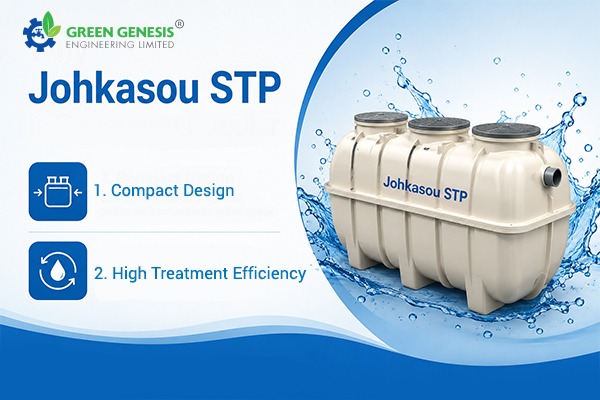
1. Compact Design
One of the biggest advantages of Johkasou technology is its compact structure. Conventional sewage treatment systems often require large tanks, multiple chambers, and significant land areas. In contrast, a Johkasou STP integrates various treatment processes within a single compact unit. This makes it ideal for urban areas where land is expensive and limited.
2. High Treatment Efficiency
A properly designed Johkasou STP can achieve excellent removal of:
- Oxygen Demand (BOD)
- Chemical Oxygen Demand (COD)
- Suspended Solids (SS)
- Ammonia Nitrogen
- Pathogenic Microorganisms
The high-quality effluent helps protect the environment and supports water conservation efforts.
3. Easy Installation
Since most Johkasou units are factory-manufactured and delivered as prefabricated systems, installation time is significantly reduced compared to conventional sewage treatment plants.
4. Lower Construction Cost
Traditional sewage treatment plants often require extensive concrete work, underground piping networks, and complex civil structures. Johkasou STP minimizes these requirements, resulting in lower construction costs and faster project completion.
5. Environmental Sustainability
Modern wastewater management focuses not only on treatment but also on environmental sustainability. Johkasou systems contribute by reducing pollution loads and enabling water reuse opportunities.
Understanding the Need for Sewage Treatment
Before discussing the working mechanism of Johkasou STP, it is important to understand why sewage treatment is necessary. Every day, wastewater generated from human activities contains various pollutants, including:
- Organic matter
- Suspended solids
- Nutrients
- Harmful bacteria
- Viruses
- Grease and oil
- Chemical contaminants
When untreated sewage enters rivers, lakes, or groundwater systems, several environmental problems occur.
Water Pollution:Untreated wastewater reduces water quality and threatens aquatic ecosystems.
Oxygen Depletion:Organic pollutants consume dissolved oxygen during decomposition, leading to fish kills and ecosystem damage.
Disease Transmission:Pathogens present in sewage can spread diseases such as cholera, typhoid, dysentery, and hepatitis.
Groundwater Contamination:Improper sewage disposal can contaminate underground water resources used for drinking and domestic purposes. For these reasons, effective wastewater treatment systems such as Johkasou STP are becoming essential components of modern infrastructure.
Main Components of a Johkasou STP
Although designs vary among manufacturers, most Johkasou STP systems contain the following key components:
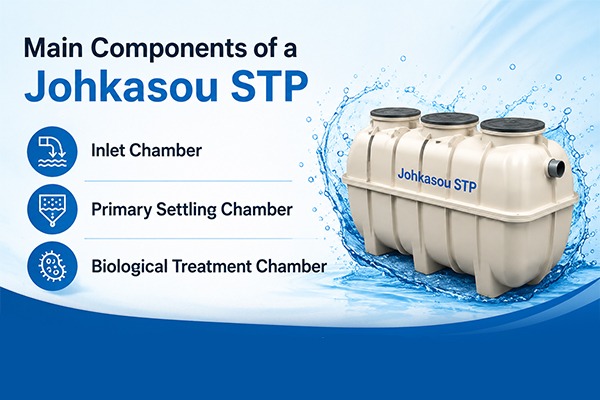
Inlet Chamber
The inlet chamber receives incoming wastewater from various sources. Its main function is to distribute sewage evenly throughout the treatment process.
Primary Settling Chamber
In this stage, heavier solids settle at the bottom while lighter materials float to the surface. This initial separation reduces the load on downstream treatment processes.
Biological Treatment Chamber
The biological treatment chamber serves as the heart of the Johkasou STP. Beneficial microorganisms break down organic pollutants present in wastewater. These microorganisms consume contaminants as food, converting them into simpler and less harmful substances.
Aeration System
Aeration introduces oxygen into the wastewater. Oxygen is essential for aerobic bacteria that perform biological treatment.The aeration system typically includes:
- Air blowers
- Diffusers
- Air distribution pipelines
Proper aeration significantly improves treatment efficiency.
Secondary Clarifier
Following biological treatment, suspended biomass settles in the clarification chamber. Clear water moves forward while settled sludge is recycled or removed.
Disinfection Chamber
Before discharge, treated water passes through a disinfection process. Common disinfection methods include:
- Chlorination
- UV Treatment
- Ozone Treatment
Disinfection eliminates harmful microorganisms and improves water safety.
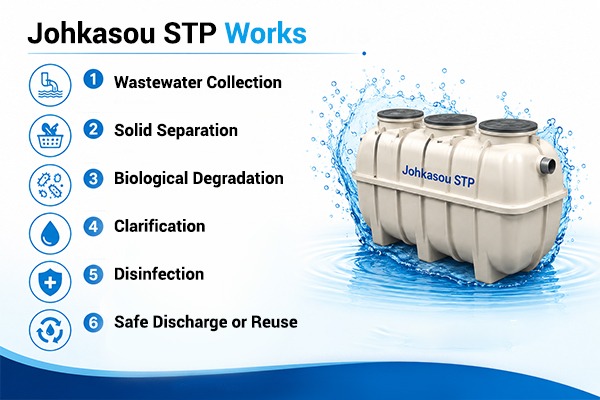
How Johkasou STP Works
The operation of a Johkasou STP follows a systematic treatment sequence.
Step 1: Wastewater Collection
Sewage enters the treatment unit from toilets, kitchens, washrooms, and other sources.
Step 2: Solid Separation
Heavy solids settle while floating materials are separated.
Step 3: Biological Degradation
Microorganisms digest organic contaminants through aerobic biological processes.
Step 4: Clarification
Biological sludge settles and is separated from treated water.
Step 5: Disinfection
Pathogens are destroyed through chemical or physical disinfection.
Step 6: Safe Discharge or Reuse
The treated water can be discharged safely or reused for non-potable applications.
Types of Johkasou STP Systems
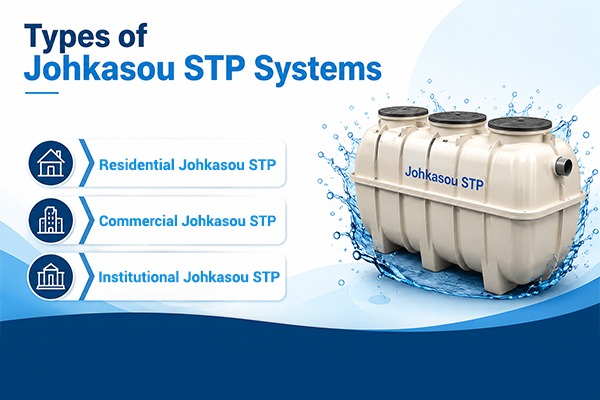
Depending on project requirements, several types of Johkasou STP systems are available.
Residential Johkasou STP
Designed for houses, apartments, and residential communities.
Commercial Johkasou STP
Suitable for shopping malls, office buildings, and commercial complexes.
Institutional Johkasou STP
Used in schools, universities, hospitals, and government facilities.
Industrial Johkasou STP
Customized for industrial wastewater containing specific pollutants.
Applications of Johkasou STP in Bangladesh
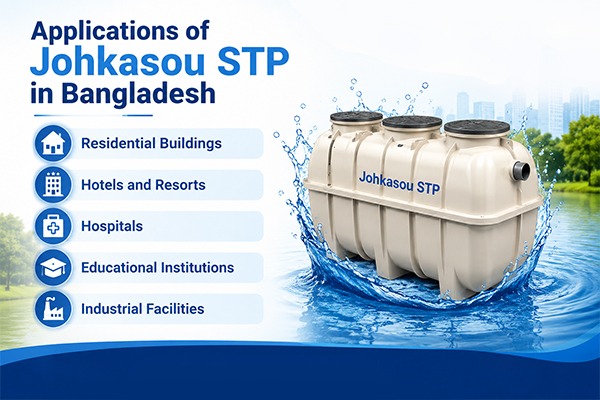
The demand for Johkasou STP in Bangladesh is growing across multiple sectors.
Residential Buildings
Modern apartment projects increasingly require sewage treatment facilities.
Hotels and Resorts
Tourism facilities generate large volumes of wastewater and benefit from compact treatment solutions.
Hospitals
Hospitals require reliable wastewater treatment to protect public health.
Educational Institutions
Schools, colleges, and universities can utilize Johkasou STP for sustainable wastewater management.
Industrial Facilities
Various industries use Johkasou technology to meet environmental compliance requirements.
Detailed Treatment Process of Johkasou STP
To understand the effectiveness of a Johkasou STP, it is important to examine how each treatment stage contributes to wastewater purification. Unlike traditional septic tanks that mainly provide sedimentation, Johkasou technology incorporates multiple treatment mechanisms that work together to achieve superior effluent quality.
Preliminary Treatment
The first stage focuses on removing large debris and coarse materials from incoming wastewater. Typical materials removed include:
- Plastic particles
- Paper waste
- Hair
- Cloth fibers
- Food residues
This stage protects downstream equipment and prevents clogging.
Primary Treatment The primary chamber allows heavier suspended particles to settle naturally. At this stage:
- Settleable solids sink to the bottom.
- Grease and oils float to the surface.
- Partial decomposition begins.
The biological chamber is the most critical section of the Johkasou STP. Specialized microorganisms consume dissolved and suspended organic matter. The process reduces:
- BOD (Biochemical Oxygen Demand)
- COD (Chemical Oxygen Demand)
- Organic pollutants
Aerobic Decomposition Aerobic bacteria require oxygen to survive. Air blowers continuously inject oxygen into the aeration chamber. This oxygen supply helps bacteria:
- Grow rapidly
- Break down pollutants efficiently
- Produce stable treated water
Clarification Process After biological treatment, mixed liquor enters a clarification chamber, Here:
- Biological sludge settles.
- Clear water moves upward.
- Excess sludge is removed.
Final Disinfection
Even after biological treatment, some microorganisms may remain. Disinfection ensures compliance with environmental discharge standards. Common disinfection methods include:
Chlorination: Widely used due to low cost and reliability.
UV Sterilization:Chemical-free and environmentally friendly.
Ozone Treatment:Highly effective but generally more expensive.
Major Advantages of Johkasou STP
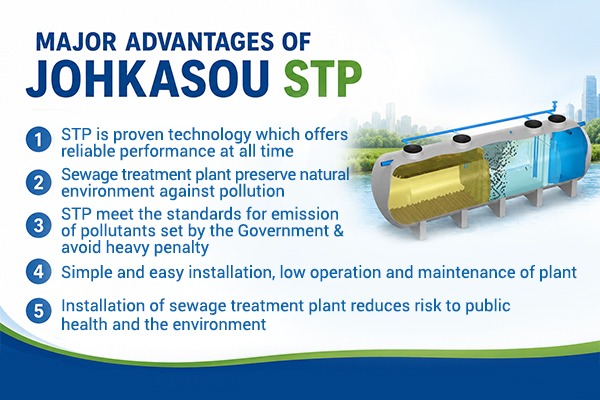
The growing demand for Johkasou STP is driven by several practical and environmental benefits. Compact Footprint Land availability is becoming a major challenge in Bangladesh. Conventional sewage treatment plants often require large spaces. A Johkasou STP can deliver similar treatment performance within a much smaller area.This advantage is particularly valuable in:
- Apartment buildings
- Hotels
- Commercial complexes
- Urban developments
Prefabricated Construction Most Johkasou units are manufactured in controlled factory environments. Benefits include:
- Better quality control
- Faster installation
- Reduced construction errors
- Lower project delays
Reduced Civil ConstructionTraditional treatment plants require:
- Large concrete tanks
- Extensive excavation
- Complex piping systems
Johkasou STP significantly reduces these requirements. As a result:
- Installation becomes easier
- Project costs decrease
- Construction time shortens
Consistent Effluent Quality One of the biggest strengths of Johkasou technology is its stable treatment performance. Properly operated systems consistently achieve:
- Low BOD levels
- Low COD levels
- Reduced suspended solids
- Effective pathogen removal
This consistency helps facilities meet environmental regulations.
Low Environmental ImpactModern wastewater treatment should protect both human health and natural ecosystems. Johkasou STP contributes by:
- Preventing river pollution
- Protecting groundwater
- Reducing disease risks
- Supporting water reuse
Johkasou STP vs Conventional STP
Many project owners ask whether they should choose a traditional sewage treatment plant or a Johkasou STP. The answer depends on several factors.
Space Requirement
- Traditional STP: Requires larger land area.
- Johkasou STP: Requires significantly less space.
- Winner: Johkasou STP
Installation Time
- Traditional STP: Long construction period.
- Johkasou STP: Rapid installation.
- Winner: Johkasou STP
Civil Construction Cost
- Traditional STP: Higher civil construction costs.
- Johkasou STP: Lower civil work requirements.
- Winner: Johkasou STP
Operational Complexity
- Traditional STP: Often requires skilled operators.
- Johkasou STP: Generally easier to operate.
- Winner: Johkasou STP
Scalability
- Traditional STP: Suitable for very large municipal projects.
- Johkasou STP: Excellent for decentralized treatment.
- Winner: Depends on project size.
Important Design Considerations
Selecting the right Johkasou STP requires proper engineering analysis. Several factors must be evaluated.
Daily Wastewater Flow
Flow rate determines treatment capacity.The designer must calculate:
- Number of users
- Water usage patterns
- Peak flow conditions
Wastewater quality varies from site to site. Key parameters include:
- BOD
- COD
- TSS
- Oil and grease
- Ammonia
Accurate wastewater analysis improves system selection.
Available Installation AreaSite dimensions influence:
- Unit size
- Installation method
- Maintenance accessibility
Environmental regulations often specify discharge limits.The treatment system must be capable of achieving these standards.
Operation and Maintenance of Johkasou STP
Even the best treatment system requires proper maintenance. Fortunately, Johkasou STP systems are relatively easy to maintain.
Routine InspectionOperators should regularly inspect:
- Blowers
- Pumps
- Diffusers
- Electrical panels
- Piping systems
Biological treatment produces sludge. Periodic sludge removal is necessary to maintain performance. The frequency depends on:
- Wastewater volume
- System capacity
- Operating conditions
Aeration is essential for biological treatment. Operators should monitor:
- Air pressure
- Blower condition
- Diffuser performance
Reduced aeration can negatively affect treatment efficiency.
Disinfection MonitoringDisinfection systems require routine checks to ensure
effectiveness. This includes:- Chlorine dosage monitoring
- UV lamp inspection
- Ozone system maintenance
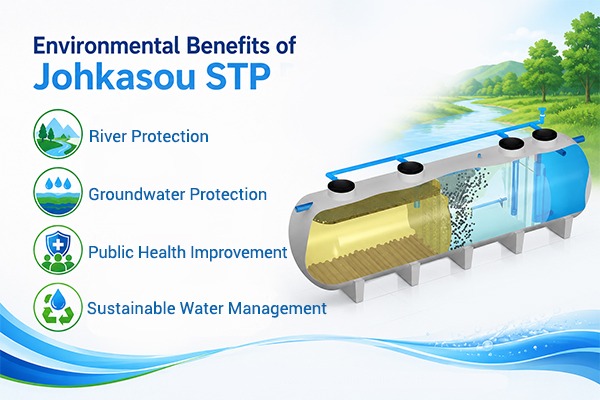
Environmental Benefits of Johkasou STP
Environmental protection is one of the strongest arguments for installing a Johkasou STP.
River ProtectionUntreated sewage is a major cause of river pollution Johkasou systems significantly reduce pollutant discharge.
Groundwater ProtectionProper wastewater treatment prevents contamination of underground water resources.This is particularly important in Bangladesh, where groundwater remains a primary source of drinking water.
Public Health ImprovementEffective sewage treatment reduces:
- Waterborne diseases
- Pathogen transmission
- Environmental contamination
Treated wastewater can often be reused for:
- Gardening
- Landscape irrigation
- Toilet flushing
- Cleaning activities
This reduces overall freshwater consumption.
Why Johkasou STP is Suitable for Bangladesh
Bangladesh faces several wastewater management challenges. These include:
- Rapid urbanization
- Population growth
- Limited land availability
- Increasing environmental regulations
Johkasou technology addresses many of these challenges effectively
Ideal for Urban Areas Major cities such as:Have limited available land for large treatment facilities. Compact Johkasou systems provide an effective solution.
Suitable for Real Estate Projects
Modern apartment developments increasingly require sewage treatment facilities to obtain environmental clearance. Johkasou STP offers developers:
- Compact design
- Fast installation
- Reliable compliance
Growing Regulatory Requirements
Environmental authorities are becoming stricter regarding wastewater discharge. Installing a Johkasou STP helps organizations comply with environmental regulations while demonstrating corporate responsibility.
Common Mistakes When Selecting a Johkasou STP
Many projects encounter problems because of poor planning. Common mistakes include:
- Selecting capacity based only on current demand.
- Ignoring future expansion requirements.
- Choosing the lowest-cost supplier without evaluating quality.
- Neglecting maintenance planning.
- Underestimating wastewater generation.
- Ignoring after-sales support.
A professional design assessment can prevent these issues.
Future of Johkasou STP Technology
The future of wastewater treatment is moving toward:
- Decentralized systems
- Water reuse
- Smart monitoring
- Energy efficiency
Johkasou STP aligns perfectly with these trends. Future developments may include:
- Remote monitoring systems
- IoT-based operation
- Automated control systems
- Improved energy efficiency
- Enhanced nutrient removal
These advancements will further strengthen the position of Johkasou STP as a leading wastewater treatment solution.
Conclusion
As Bangladesh continues to urbanize and industrialize, effective wastewater treatment is no longer optional—it is essential. A Johkasou STP provides a practical, efficient, and environmentally responsible solution for treating domestic sewage and wastewater. Its compact design, high treatment efficiency, easy installation, and low operational requirements make it an attractive choice for residential buildings, hotels, hospitals, educational institutions, commercial facilities, and industrial projects. Compared with conventional sewage treatment systems, Johkasou STP offers significant advantages in terms of space savings, construction simplicity, environmental compliance, and long-term sustainability. Organizations seeking a reliable sewage treatment solution should carefully evaluate the benefits of Johkasou technology and select a system that matches their specific requirements. With increasing environmental awareness and stricter regulatory standards, the adoption of Johkasou STP is expected to grow rapidly across Bangladesh in the coming years, helping create cleaner communities, healthier ecosystems, and a more sustainable future.
Cost Factors of Johkasou STP
When planning to install a Johkasou STP, understanding the factors that influence project cost is essential. While many people focus only on the initial purchase price, the total investment depends on several technical and operational considerations.
Treatment Capacity
The capacity of a Johkasou STP is one of the primary factors affecting cost. Systems designed for a small residential building will naturally cost less than those required for a hotel, hospital, or large commercial complex. Typical capacities may range from:
- 5 KLD (Kiloliters per Day)
- 10 KLD
- 20 KLD
- 50 KLD
- 100 KLD and above
As capacity increases, equipment size, aeration requirements, and treatment chambers also increase.
Tank Material
Johkasou STP tanks are commonly manufactured using:
FRP (Fiber Reinforced Plastic)Advantages:
- Lightweight
- Corrosion resistant
- Easy transportation
- Fast installation
RCC (Reinforced Cement Concrete)
Advantages:
- Strong structure
- Suitable for large projects
Advantages:
- Excellent chemical resistance
- Long service life
The selected material directly impacts project cost and installation requirements.
Effluent Quality RequirementsDifferent projects require different treated water standards. For example:
- Standard discharge quality
- Landscape irrigation quality
- Water reuse quality
Higher effluent standards often require additional treatment stages, increasing overall investment.
Challenges in Wastewater Management in Bangladesh
Bangladesh is experiencing rapid urban growth, creating significant pressure on wastewater infrastructure. Many residential and commercial developments still rely on traditional septic tanks that provide limited treatment.Some common challenges include:
Lack of Centralized Sewer NetworksMany cities and municipalities do not have comprehensive sewer systems. As a result, decentralized solutions such as Johkasou STP become highly practical.
Land ScarcityUrban land prices continue to rise.
Large conventional sewage treatment facilities are often difficult to accommodate. Compact Johkasou systems provide an effective alternative.
Environmental ConcernsPolluted rivers and canals remain a major concern throughout the country. Proper wastewater treatment is necessary to protect:
- Surface water
- Groundwater
- Aquatic ecosystems
- Public health
Water Reuse Opportunities with Johkasou STP
One of the most valuable advantages of a Johkasou STP is its ability to support water reuse programs. With increasing pressure on freshwater resources, treated wastewater can become a valuable resource. Landscape Irrigation Treated water can be used for:
- Garden irrigation
- Lawn maintenance
- Tree plantations
This reduces demand for fresh water.
Toilet FlushingMany commercial buildings now reuse treated wastewater for flushing systems. Benefits include:
- Reduced water bills
- Improved sustainability
- Lower freshwater consumption
Depending on treatment quality, reclaimed water may be used for:
- Floor washing
- Vehicle washing
- Outdoor cleaning activities
How to Select the Right Johkasou STP Supplier
Choosing the right supplier is just as important as choosing the right treatment technology. Before making a purchase decision, consider the following factors.
Engineering ExperienceA supplier with extensive wastewater treatment experience can provide:
- Proper design support
- Capacity calculation
- Site assessment
- Installation guidance
A high-quality Johkasou STP should offer:
- Durable construction
- Reliable equipment
- Long service life
- Stable treatment performance After-Sales Service
- Service availability
- Spare parts support
- Technical assistance
- Emergency response capability
- Hotels
- Hospitals
- Residential projects
- Commercial buildings
Wastewater treatment systems require periodic maintenance and technical support. Always verify:
Reviewing previous installations helps assess supplier credibility.Ask for examples from:
Frequently Asked Questions About Johkasou STP
Is Johkasou STP suitable for apartment buildings?
Yes. Johkasou STP is widely used in residential apartment projects due to its compact design and reliable treatment performance.
Can treated water be reused?
Yes. Depending on treatment quality and local regulations, treated water can often be reused for gardening, flushing, and cleaning applications.
Does Johkasou STP require skilled operators?
Compared to many conventional sewage treatment plants, Johkasou systems are relatively easy to operate. However, routine monitoring and maintenance remain important.
How long does a Johkasou STP last?
A properly maintained Johkasou STP can provide reliable service for many years. The lifespan depends on tank material, equipment quality, and maintenance practices.
Is Johkasou STP environmentally friendly?
Yes. Johkasou technology significantly reduces wastewater pollution and supports sustainable water management practices.
Final Thoughts
The future of wastewater treatment lies in compact, efficient, and environmentally responsible technologies. As Bangladesh continues to face challenges related to urbanization, environmental protection, and water resource management, Johkasou STP offers a practical and sustainable solution. Whether for a residential apartment, commercial complex, hospital, educational institution, hotel, or industrial facility, a properly designed Johkasou STP can provide reliable wastewater treatment while minimizing environmental impact. Investing in a quality Johkasou STP is not only a regulatory requirement in many cases—it is also a commitment to public health, environmental sustainability, and responsible development.