Introduction
In pump engineering, one of the most critical design parameters is NPSH (Net Positive Suction Head). Whether the application is water treatment plants, industrial factories, RO systems, irrigation projects, or municipal water supply in Bangladesh, understanding NPSH is essential for reliable and efficient operation.
Many pump failures in Bangladesh occur not because of poor pump quality, but due to improper suction design and incorrect NPSH calculation. Cavitation, vibration, mechanical seal damage, impeller erosion, and reduced performance are often the direct results of insufficient NPSH.
This comprehensive technical guide explains NPSH in detail, including theory, calculation methods, practical applications, troubleshooting, and system design recommendations for Bangladesh conditions.
1. What is NPSH?
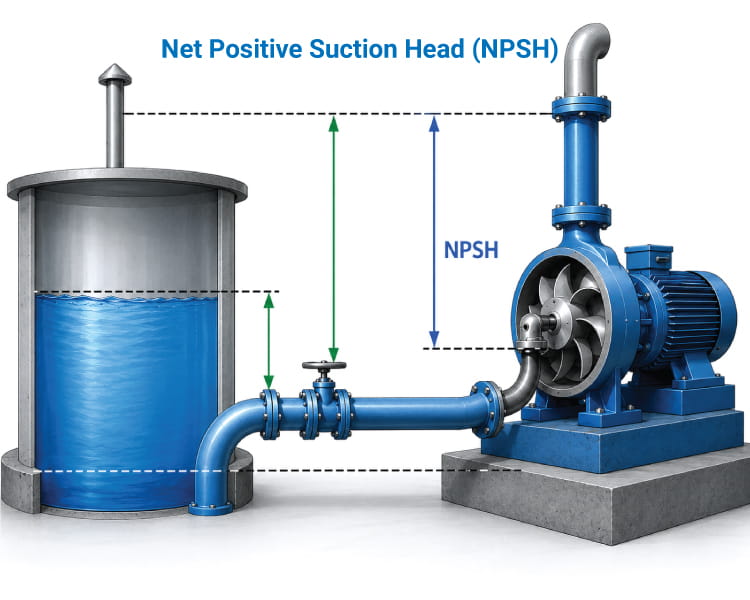
NPSH (Net Positive Suction Head) is the total pressure energy available at the pump suction inlet to keep the liquid in stable condition and prevent vaporization.
In simple engineering terms:
NPSH ensures that the pressure at the pump suction remains higher than the vapor pressure of the liquid. If suction pressure falls below vapor pressure, the liquid begins to form vapor bubbles. This leads to cavitation, which can severely damage pump components.
2. Understanding the Physics Behind NPSH
To fully understand NPSH, we must review some fluid mechanics principles.
Bernoulli’s PrincipleAccording to Bernoulli’s equation: When fluid velocity increases, pressure decreases. Inside a pump suction line:
- If velocity becomes too high (due to small pipe diameter), pressure decreases.
- If pressure drops too much, vapor bubbles form.
Therefore, proper suction design is essential.
Vapor Pressure ConceptEvery liquid has a vapor pressure depending on temperature. When system pressure becomes equal to vapor pressure:
- Boiling begins.
- Vapor bubbles form even without heating.
For example:
- Water at 25°C has low vapor pressure.
- Water at 70°C has much higher vapor pressure.
- Higher temperature → Higher vapor pressure → Lower NPSH available.
3. Types of NPSH
There are two important types:
3.1 NPSH Available (NPSHa)
This is the actual suction head available in your system.
It depends on:
- Atmospheric pressure
- Static suction head
- Friction losses in piping
- Liquid temperature
- Installation height
NPSHa is calculated based on real field conditions.
3.2 NPSH Required (NPSHr)
This value is provided by the pump manufacturer. It represents the minimum suction head required to avoid cavitation at a specific flow rate and speed.
Important:
- NPSHr increases as flow rate increases.
- NPSHr is shown in pump performance curves.
4. Basic NPSH Formula
The general formula for NPSH Available is:
NPSHa=(Patm+Hs-Hf-Hv)
Where:
- Patm = Atmospheric pressure head
- Hs = Static suction head
- Hf = Friction losses
- Hv = Vapor pressure head
5. Detailed Explanation of Each Component
5.1 Atmospheric Pressure
- At sea level, atmospheric pressure is approximately:
- 10.33 meters of water column.
- In Bangladesh (near sea level), this value is generally close to this standard.
- If altitude increases, atmospheric pressure decreases.
5.2 Static Suction Head
This is the vertical distance between liquid level and pump centerline.
Two conditions:
Flooded Suction:Liquid level is above pump → Positive head.
Suction Lift:Pump is above liquid level → Negative head.
Flooded suction improves NPSHa significantly.
5.3 Friction Losses
Friction losses occur due to:
- Pipe length
- Pipe diameter
- Elbows and bends
- Valves
- Fittings
- Strainers
Long suction pipelines in Bangladesh factories often create high friction losses, reducing NPSH.
Best practice:
- Use short suction lines.
- Use larger pipe diameter.
- Minimize bends.
5.4 Vapor Pressure Head
This depends on temperature.
Higher temperature → Higher vapor pressure → Lower NPSHa.
In hot industrial water systems, vapor pressure must be carefully considered.
6. Cavitation: The Result of Low NPSH
Cavitation occurs when:
NPSHa < NPSHr
When this happens:
- Vapor bubbles form.
- Bubbles travel to high-pressure zone.
- They collapse violently.
- Shock waves damage metal surfaces.
- Impeller pitting
- Noise (gravel-like sound)
- Vibration
- Reduced discharge pressure
- Seal failure
- Efficiency drop
- Increased maintenance cost
Cavitation is one of the main causes of pump failure in Bangladesh industrial systems.
7. NPSH in Bangladesh Industrial Applications
7.1 Water Treatment Plants
Especially in:
- RO systems
- Chemical dosing systems
- High-pressure pumps
Proper suction design is critical.
7.2 Textile Industry
Large factories use multiple pumps.
Improper NPSH causes frequent breakdowns.
7.3 Irrigation Projects
Deep well pumps and long suction lines require careful NPSH consideration.
7.4 Municipal Water Supply
Urban systems must maintain stable pressure to avoid cavitation.
How to Calculate NPSHa (Step-by-Step Example)
Assume:
- Atmospheric head = 10.3 m
- Static suction lift = 2 m
- Friction loss = 1.5 m
- Vapor pressure head = 0.5 m
Then:
NPSHa = 10.3 − 2 − 1.5 − 0.5
NPSHa = 6.3 meters
Now compare with pump NPSHr.
If NPSHr = 4 meters → System is safe.
9. Safety Margin in Professional Design
Engineers do not design system at exact equality.
Recommended condition:
NPSHa ≥ NPSHr + Safety Margin
Safety margin typically:
• 0.5 m to 1 m
• Or 10–20% additional allowance
This ensures long-term reliability.
10. How to Improve NPSH in Real Systems
If NPSHa is low:
Increase Suction Pipe Diameter
Reduces velocity and friction loss.
Shorten Suction Line
Less distance = Less pressure drop.
Reduce Bends and Valves
Each fitting increases resistance.
Install Pump Below Liquid Level
Flooded suction greatly improves NPSH.
Lower Liquid Temperature
Reduces vapor pressure.
Use Booster Pump
For critical systems.
Select Pump with Lower NPSHr
Different pump designs have different suction characteristics.
11. NPSH and Pump Efficiency
When NPSH is insufficient:
- Efficiency decreases
- Power consumption may rise
- Flow becomes unstable
- Mechanical stress increases
Proper NPSH improves energy efficiency.
13. Common Engineering Mistakes
Many projects fail due to:
- Ignoring suction design
- Using small diameter pipes
- Installing pump too high
- Not reviewing NPSHr curve
- Overlooking temperature impact
Proper engineering review prevents these problems.
14. Relationship Between NPSH and Pump Speed
Higher RPM increases NPSHr. When selecting pumps:
- Always check performance curve.
- Ensure system NPSHa is sufficient at operating flow.
Practical Recommendations for Bangladesh Market
For reliable pump installation:
- Always design flooded suction when possible.
- Keep suction line short.
- Use large diameter pipes.
- Maintain proper maintenance.
- Verify NPSH before commissioning.
- Check manufacturer curve carefully.
16. Economic Impact of Proper NPSH
Correct NPSH design leads to:
- Lower repair cost
- Longer equipment life
- Reduced downtime
- Higher productivity
- Improved customer satisfaction
In industrial Bangladesh projects, this can save significant operational cost.
17. Final Technical Summary
NPSH is a fundamental concept in pump engineering.
To ensure reliable system performance:
- Calculate NPSHa correctly.
- Compare with NPSHr.
- Maintain safety margin.
- Design proper suction piping.
- Avoid cavitation risk.
Understanding NPSH is essential for engineers, contractors, and water treatment professionals in Bangladesh. Proper suction design guarantees:
-
✔ Smooth operation
✔ High efficiency
✔ Long pump life
✔ Reduced maintenance
✔ Stable system performance
Conclusion
Whether you are installing pumps in:
- RO plants
- Industrial factories
- Irrigation systems
- Water supply projects
- Commercial buildings
NPSH must always be considered in system design. Ignoring NPSH can result in serious technical and financial losses. For sustainable pump performance in Bangladesh, correct NPSH calculation is not optional — it is mandatory engineering practice.