Introduction
The RBC STP (Rotating Biological Contactor Sewage Treatment Plant) is a biological wastewater treatment technology designed to treat domestic sewage and biodegradable wastewater through the natural activity of microorganisms. RBC systems use a series of closely spaced circular discs that slowly rotate while partially submerged in wastewater. As the discs rotate, microorganisms grow as a biological film on their surfaces and alternately come into contact with wastewater and atmospheric oxygen. This unique rotating mechanism allows the microorganisms to absorb and break down biodegradable organic pollutants from wastewater while receiving oxygen from the atmosphere. The process provides an efficient balance between wastewater contact and oxygen exposure, making the Biological Contactor (RBC) a practical solution for selected residential, commercial, institutional, and decentralized wastewater treatment applications. An RBC-based STP can be designed to provide reliable biological treatment with relatively simple operation and controlled energy consumption. Depending on the required treated water quality, additional clarification, filtration, and disinfection stages can be integrated into the overall treatment system.
What is an RBC STP?
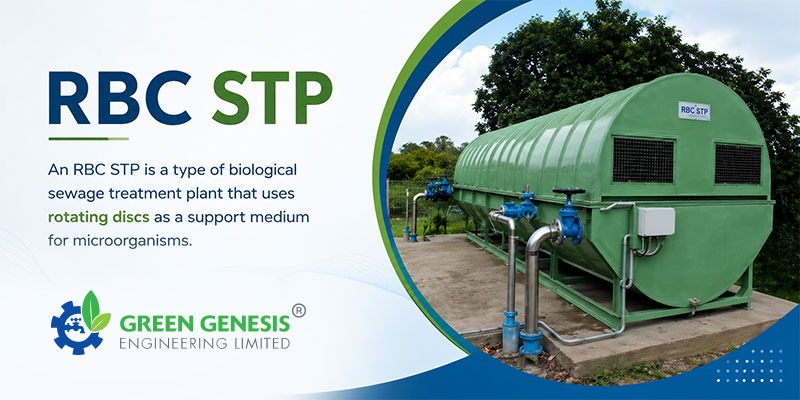
An RBC STP is a type of biological sewage treatment plant that uses rotating discs as a support medium for microorganisms. The full name, Rotating Biological Contactor, describes the fundamental working principle:
- Rotating – The discs continuously rotate at a controlled speed.
- Biological – Microorganisms growing on the disc surfaces biologically treat the wastewater.
- Contactor – The rotating discs repeatedly bring the biological film into contact with wastewater and oxygen.
The discs are mounted on a horizontal shaft and installed inside a treatment tank. A portion of each disc is submerged in wastewater, while the remaining portion is exposed to air. As the shaft rotates, the biological film alternately moves through the wastewater and the atmosphere. During the submerged phase, microorganisms come into contact with organic pollutants in the wastewater. During the exposed phase, the microorganisms receive oxygen from the air. This continuous cycle supports biological wastewater treatment without requiring the same type of continuous air supply used in conventional suspended-growth systems.
How Does a Rotating Biological Contactor STP Work?
The basic operation of an RBC STP can be summarized as:
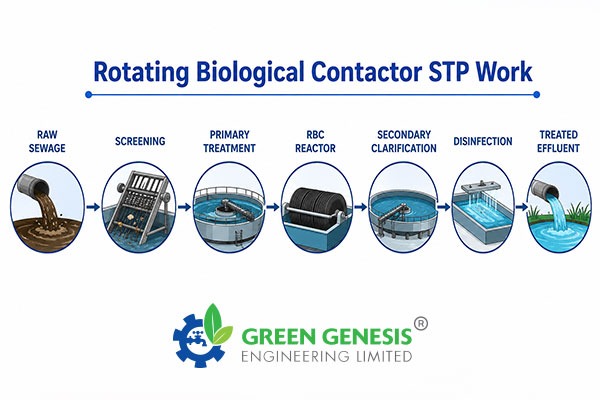
Raw Sewage → Screening → Primary Treatment → RBC Reactor → Secondary Clarification → Disinfection → Treated Effluent
Depending on the project requirements, additional treatment units may be incorporated. The RBC reactor is the central biological treatment stage. The treatment process generally works as follows:
- Raw sewage enters the STP.
- Large solids are removed through screening.
- Grit and other heavy materials are removed where required.
- Primary treatment reduces the incoming solids and organic load.
- Pre-treated wastewater enters the RBC tank.
- Microorganisms attached to the rotating discs come into contact with wastewater.
- The rotating discs expose the microorganisms to atmospheric oxygen.
- The biological film consumes biodegradable organic matter.
- Excess biological growth eventually detaches from the discs.
- Detached biological solids are separated in a secondary clarifier.
- The clarified water undergoes disinfection or additional polishing.
- The treated effluent is discharged or considered for suitable reuse applications.
The RBC Reactor – The Heart of the System
The RBC reactor contains a series of large circular discs mounted on a horizontal shaft. The discs are typically manufactured from durable materials suitable for long-term exposure to wastewater and environmental conditions. The shaft rotates slowly using a mechanical drive system. The discs are partially submerged in wastewater, allowing approximately a portion of their surface area to remain continuously exposed to air. As the discs rotate:
Disc Surface → Wastewater Contact → Rotation → Air Exposure → Oxygen Transfer → Continuous Biological Treatment
A biological film gradually develops on the disc surfaces. This biofilm contains microorganisms that consume biodegradable pollutants present in the wastewater. The rotating action creates a highly controlled environment where microorganisms repeatedly alternate between wastewater contact and atmospheric oxygen exposure.
Biofilm – The Biological Engine of RBC STP
The most important feature of an RBC system is the biological film, or biofilm, that develops on the disc surfaces. The biofilm consists of communities of microorganisms that attach themselves naturally to the rotating media. These microorganisms use biodegradable organic matter in wastewater as a food source. As wastewater flows through the RBC reactor, the microorganisms absorb and metabolize organic pollutants. The biological film may contain different microbial communities depending on the reactor conditions and treatment objectives. The outer layers of the biofilm generally have better access to oxygen, while deeper layers may experience lower oxygen availability. This layered biological structure allows different microbial activities to occur within the biofilm.
Oxygen Transfer in an RBC System
One of the unique features of an RBC STP is its method of oxygen supply. Unlike conventional Activated Sludge Process systems that normally require blowers and diffusers to continuously introduce air into the aeration tank, RBC systems expose the biological media directly to atmospheric air through disc rotation. When the discs rotate out of the wastewater, the attached biofilm is exposed to oxygen in the atmosphere. When the discs rotate back into the wastewater, the oxygenated biological film comes into contact with wastewater and uses the available oxygen to support biological treatment. This repeated exposure provides oxygen to the microorganisms and supports the biological degradation of organic pollutants. The actual oxygen transfer performance depends on factors such as:
- Disc rotation speed
- Disc design
- Submergence level
- Wastewater temperature
- Organic loading
- Biofilm characteristics
- Reactor configuration
Main Components of an RBC STP
A complete RBC-based Sewage Treatment Plant may include several treatments and supporting units.
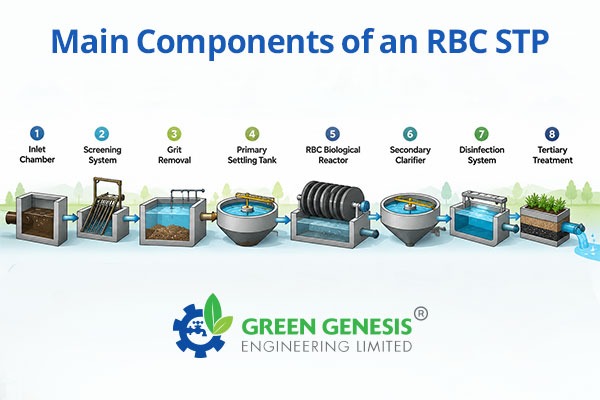
1. Inlet Chamber
The inlet chamber receives raw sewage from the collection system and directs it toward preliminary treatment. Flow measurement and flow control arrangements may also be incorporated depending on the plant design.
2. Screening System
Screening removes large floating and suspended materials from incoming sewage. Typical materials removed include:
- Plastics
- Cloth
- Paper
- Sanitary waste
- Packaging materials
- Large debris
Proper screening protects pumps and mechanical equipment and reduces the risk of blockage.
3. Grit Removal
Grit removal may be included to eliminate heavy inorganic materials such as:
- Sand
- Gravel
- Small stones
- Glass
- Other dense particles
This helps prevent unwanted accumulation and mechanical wear.
4. Primary Settling Tank
A primary settling tank may be used before the RBC reactor. Its purpose is to remove settleable solids and reduce the organic load entering the biological treatment stage. By reducing the solids and organic loading before the RBC reactor, the system can operate more effectively. The exact requirement for primary treatment depends on the plant capacity and design configuration.
5. RBC Biological Reactor
The RBC reactor contains the rotating discs and mechanical drive assembly. The discs are partially submerged in wastewater and rotate continuously at a controlled speed. Microorganisms grow on the disc surfaces and biologically degrade organic pollutants as wastewater passes through the reactor. For larger treatment requirements, multiple RBC stages may be arranged in series. This staged configuration allows the biological treatment process to progress through different loading conditions.
6. Secondary Clarifier
After biological treatment, detached biological solids are separated from the treated wastewater. The secondary clarifier allows these solids to settle by gravity. The clarified water flows from the upper section of the clarifier, while settled sludge is collected from the bottom. The sludge may be transferred to a sludge holding or dewatering system.
7. Disinfection System
Depending on the final application of treated water, disinfection may be required. Common disinfection methods include:
- UV disinfection
- Chlorination
- Sodium hypochlorite dosing
- Other approved disinfection technologies
Disinfection helps reduce pathogenic microorganisms in the final treated effluent.
8. Tertiary Treatment
Where higher-quality treated water is required, additional polishing stages may be incorporated. These may include:
- Sand filtration
- Multimedia filtration
- Activated carbon filtration
- Membrane filtration
- Ultrafiltration
The selection of tertiary treatment depends on the intended reuse or discharge requirements.
RBC STP Treatment Process Flow
A typical RBC STP may follow the process:
Inlet Sewage
↓
Screening
↓
Grit Removal
↓
Primary Settling
↓
RBC Biological Reactor
↓
Secondary Clarifier
↓
Filtration / Tertiary Treatment
↓
Disinfection
↓
Treated Water
The sludge stream may follow:
Primary Sludge + Secondary Biological Sludge↓
Sludge Holding Tank
↓
Sludge Dewatering
↓
Final Disposal or Further Treatment
The actual process configuration may vary depending on wastewater characteristics, capacity, site conditions, and required treated effluent quality.
Staged RBC Treatment
For many applications, RBC reactors are designed with multiple stages. The first stage receives the highest organic loading, while later stages receive progressively lower organic concentrations. This arrangement creates different biological environments throughout the reactor. The advantages of staged RBC treatment may include:
- Improved organic matter removal
- Better process stability
- More efficient use of biological media
- Potential support for nitrification in later stages
- Better control of biological loading
The number of stages should be determined through proper engineering design.
Nitrification in RBC STP
RBC systems can be designed to support biological nitrification when appropriate operating conditions are maintained. Nitrification is the biological conversion of ammonia into oxidized nitrogen compounds, primarily nitrate. Nitrifying microorganisms generally grow more slowly than many microorganisms responsible for organic matter removal. Because RBC systems retain microorganisms as attached biofilm, they can provide favorable conditions for maintaining specialized microbial communities. Later RBC stages, where the organic load is lower, may provide suitable conditions for nitrifying microorganisms. If nitrogen removal is required, additional anoxic treatment stages may be incorporated into the overall process design.
Advantages of RBC STP
The Rotating Biological Contactor offers several potential advantages for appropriate wastewater treatment applications.
Low Mechanical Complexity
Compared with some conventional biological treatment systems, RBC plants can have relatively simple biological treatment configurations.
Energy Efficiency Potential
Because oxygen is transferred through the rotation of the biological discs and exposure to atmospheric air, RBC systems may have lower aeration energy requirements than some conventional aerated biological processes. However, energy consumption still depends on shaft drive requirements, wastewater characteristics, plant capacity, and system design.
Compact Biological Treatment
RBC systems can provide a relatively high effective biological surface area within a controlled reactor footprint.
Simple Biological Operation
The attached-growth biological process can provide stable treatment when properly designed and maintained.
Reduced Aeration Equipment
Unlike conventional Activated Sludge systems, RBC reactors generally do not require the same type of continuous air blower and diffuser system for biological oxygen supply.
Good Process Stability
Attached-growth microorganisms can remain within the reactor without depending entirely on suspended biomass concentration.
Potential for Nitrification
Properly designed multi-stage RBC systems can support nitrification and advanced biological treatment requirements.
Limitations of RBC STP
Although RBC technology offers several benefits, it also has certain limitations that should be considered during project planning.
Mechanical Components
The rotating shaft, bearings, drive system, and supporting structures require proper engineering and preventive maintenance.
Mechanical Failure Risk
Failure of the drive assembly or shaft can interrupt biological treatment.
Disc Damage
The discs must be protected from large solids and debris through effective preliminary treatment.
Cold Weather Considerations
Temperature can influence biological activity and treatment performance.
Shock Loads
Sudden changes in wastewater flow or pollutant concentration can affect biological performance.
Sludge Management
Detached biofilm and settled solids still require appropriate sludge handling and disposal. Proper design and maintenance can significantly reduce these challenges.
RBC STP vs. Activated Sludge Process STP
Both RBC and Activated Sludge Process systems use microorganisms to biologically treat wastewater, but their biological growth mechanisms are different. In an ASP STP, microorganisms are primarily suspended in the mixed liquor within the aeration tank. In an RBC STP, microorganisms grow mainly as an attached biofilm on rotating discs. The RBC process uses rotating media to provide alternating contact with wastewater and atmospheric oxygen, while ASP typically uses mechanical or diffused aeration to supply oxygen to suspended microorganisms. The appropriate technology depends on:
- Wastewater flow
- Organic loading
- Available land
- Energy requirements
- Operator expertise
- Site conditions
- Required effluent quality
- Future expansion
A detailed engineering evaluation should be carried out before selecting the treatment technology.
RBC STP vs. MBBR STP
Both RBC and MBBR are attached-growth biological treatment technologies. However, their biological media operate differently. In an RBC system, the biological media are large rotating discs mounted on a shaft. In an MBBR system, microorganisms grow on small carrier media that move freely within an aerated or mixed reactor. RBC systems rely on mechanical rotation to alternate the biofilm between wastewater and air. MBBR systems generally use aeration or mixing to move the carrier media and provide oxygen. The choice between the two technologies depends on project-specific technical and economic considerations.
RBC STP Applications
RBC technology may be considered for various wastewater treatment applications. These include:
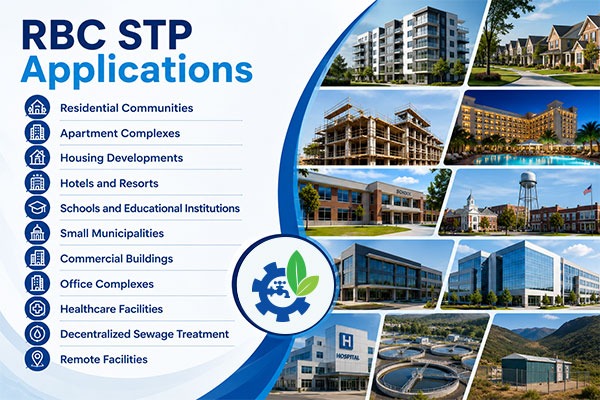
- Residential Communities
- Apartment Complexes
- Housing Developments
- Hotels and Resorts
- Schools and Educational Institutions
- Small Municipalities
- Commercial Buildings
- Office Complexes
- Healthcare Facilities
- Decentralized Sewage Treatment
- Remote Facilities
RBC systems may be particularly suitable where reliable biological treatment is required and the project benefits from an attached-growth process with relatively straightforward biological operation.
RBC STP for Residential Projects
Residential communities generate wastewater with relatively predictable biodegradable characteristics. An RBC STP can be designed to treat sewage generated from:
- Apartment buildings
- Housing projects
- Residential complexes
- Worker accommodation
- Gated communities
The required capacity should be determined based on population, water consumption, wastewater generation, peak flow, and applicable treatment standards.
RBC STP for Hotels and Commercial Facilities
Hotels, resorts, offices, and commercial buildings often experience variations in wastewater flow throughout the day. RBC STP systems can be designed to accommodate such wastewater characteristics when appropriate equalization and preliminary treatment are provided. Additional treatment may be required when the treated water is intended for reuse.
RBC STP for Decentralized Wastewater Treatment
RBC technology can be considered for decentralized wastewater treatment applications where wastewater is treated near the point of generation. Potential applications include:
- Remote communities
- Resorts
- Institutional campuses
- Residential developments
- Rural facilities
Decentralized treatment can reduce the need for long-distance wastewater transportation and may support local water reuse initiatives.
RBC STP Operation and Maintenance
Although RBC systems can offer relatively simple biological operation, regular maintenance is essential. Important maintenance activities include:
- Checking shaft alignment
- Inspecting bearings
- Lubricating mechanical components
- Checking drive motors
- Inspecting gearboxes
- Monitoring disc condition
- Checking rotation speed
- Removing accumulated solids
- Inspecting clarifiers
- Monitoring treated water quality
The RBC drive system should be inspected regularly to prevent unexpected mechanical failures.
RBC STP Design Considerations
A successful RBC STP requires careful engineering based on actual wastewater characteristics. Important design considerations include:
- Average wastewater flow
- Peak wastewater flow
- BOD concentration
- COD concentration
- TSS concentration
- Ammonia concentration
- Nitrogen requirements
- Required effluent quality
- Hydraulic loading
- Organic loading
- Disc surface area
- Disc submergence
- Number of RBC stages
- Shaft rotation speed
- Mechanical drive requirements
- Sludge generation
- Site conditions
- Future expansion
For industrial wastewater or unusual sewage characteristics, laboratory testing or pilot studies may be recommended before finalizing the design.
Common Operating Parameters
Important parameters for RBC STP operation may include:
- Influent flow
- BOD
- COD
- TSS
- Ammonia
- pH
- Temperature
- Dissolved Oxygen
- Hydraulic loading
- Organic loading
- Disc rotation speed
- Disc submergence
- Sludge production
Regular monitoring allows operators to identify changes in process performance and take corrective action when necessary.
Energy Efficiency of RBC STP
Energy consumption is an important consideration in wastewater treatment. RBC systems may offer energy-saving potential because the biological process does not normally rely on continuous blower-based aeration in the same way as conventional Activated Sludge systems. The primary energy demand is generally associated with rotating the disc assembly and operating pumps and other supporting equipment. Energy performance depends on:
- Reactor size
- Shaft speed
- Disc design
- Organic loading
- Mechanical efficiency
- Pumping requirements
Proper equipment selection and preventive maintenance can help maintain efficient operation.
Why Choose an RBC STP?
The Rotating Biological Contactor is a well-established attached-growth biological treatment technology that can provide reliable wastewater treatment when appropriately designed and operated. Its combination of rotating biological media, natural oxygen exposure, attached microbial growth, and staged biological treatment makes it a practical option for selected sewage treatment applications. RBC systems can offer a balance between biological treatment performance, operational simplicity, and energy efficiency potential. However, the technology should always be selected based on a complete assessment of wastewater characteristics, project capacity, land availability, environmental requirements, and long-term operational considerations.
Professional RBC STP Solutions
Every wastewater treatment project is different. A successful RBC STP should be designed according to the specific wastewater flow, pollutant characteristics, required treated water quality, site conditions, and applicable environmental regulations. A professional wastewater treatment solution may include:
Wastewater Analysis → Process Selection → Detailed Engineering → Equipment Selection → Manufacturing → Installation → Commissioning → Operator Training → After-Sales Support
This integrated approach helps ensure that the RBC STP performs reliably throughout its operating life. Whether the requirement is for a residential development, hotel, institutional facility, commercial complex, or decentralized wastewater treatment project, an appropriately designed RBC STP can provide an effective biological treatment solution.
Frequently Asked Questions (FAQs) About RBC STP
1. What is an RBC STP?
An RBC STP, or Rotating Biological Contactor Sewage Treatment Plant, is a biological wastewater treatment system that uses slowly rotating discs to support the growth of microorganisms. These microorganisms form a biological film on the disc surfaces and remove biodegradable organic pollutants from sewage.
2. What does RBC stand for in wastewater treatment?
RBC stands for Rotating Biological Contactor. It is an attached-growth biological treatment technology in which microorganisms grow on rotating discs that are partially submerged in wastewater.
3. How does an RBC STP work?
In an RBC STP, a series of circular discs are mounted on a horizontal shaft and partially submerged in wastewater. As the discs rotate, the biological film attached to their surfaces alternately contacts wastewater and atmospheric air. The microorganisms consume biodegradable organic matter from the sewage while receiving oxygen from the air.
4. What is the main purpose of an RBC STP?
The main purpose of an RBC STP is to biologically treat domestic sewage and suitable biodegradable wastewater by reducing organic pollutants such as BOD and biodegradable COD. Additional treatment stages can be included to achieve specific effluent quality requirements.
5. What is the biological media used in an RBC system?
The biological media in an RBC system consists of a series of large circular discs mounted on a rotating shaft. Microorganisms naturally attach themselves to the disc surfaces and develop a biofilm that performs the biological treatment.
6. How much of the RBC disc is submerged in wastewater?
RBC discs are normally installed so that only a portion of their total surface area is submerged in wastewater, while the remaining portion is exposed to atmospheric air. The exact submergence level is determined during engineering design based on process requirements.
7. Why do RBC discs rotate?
The discs rotate to continuously alternate the attached biofilm between wastewater and air. When submerged, microorganisms come into contact with organic pollutants in wastewater. When exposed to air, they receive oxygen needed for biological activity.
8. Does an RBC STP require an air blower?
An RBC biological reactor generally does not require the same continuous blower-and-diffuser aeration arrangement used in a conventional Activated Sludge Process. Oxygen is primarily obtained through the rotation of the discs and exposure of the biofilm to atmospheric air. However, pumps, motors, and other auxiliary equipment may still require electrical energy.
9. What microorganisms are present in an RBC STP?
The biofilm may contain different communities of microorganisms, including bacteria and other biological organisms. The microbial population changes according to wastewater characteristics, organic loading, oxygen availability, temperature, and the stage of the RBC reactor.
10. What is biofilm in an RBC STP?
Biofilm is a layer of microorganisms that naturally grows and attaches to the surface of the rotating discs. This biological layer is responsible for consuming and breaking down biodegradable organic pollutants present in the wastewater.
11. What happens to excess biofilm in an RBC STP?
As the biofilm grows thicker, some of the older biological material naturally detaches from the disc surface. This process is known as sloughing. The detached biological solids are then carried with the wastewater to the secondary clarifier, where they settle and are removed as sludge.
12. Does an RBC STP require a secondary clarifier?
In most conventional RBC STP configurations, a secondary clarifier is used after the RBC biological reactor to separate detached biological solids from the treated wastewater. The exact configuration depends on the overall plant design.
13. What is the typical process flow of an RBC STP?
A typical RBC STP may follow this treatment sequence:
Screening → Grit Removal → Primary Settling → RBC Biological Reactor → Secondary Clarification → Filtration or Tertiary Treatment → Disinfection → Treated Water
The actual process flow may vary depending on wastewater characteristics and final effluent requirements.
14. Can an RBC STP treat domestic sewage?
Yes. RBC STPs are well suited for treating domestic sewage generated by residential buildings, apartment complexes, housing developments, hotels, resorts, offices, institutions, and other similar facilities.
15. Can RBC technology be used for industrial wastewater?
RBC technology can be considered for selected industrial wastewater applications where the wastewater contains biodegradable organic matter that is suitable for biological treatment. However, industrial wastewater should be carefully analyzed because toxic chemicals, high salinity, extreme pH, or other inhibitory substances can affect biological microorganisms.
16. Is an RBC STP suitable for hotels and resorts?
Yes. RBC STPs can be designed for hotels, resorts, and similar commercial facilities. The design should account for variations in occupancy, wastewater flow, organic loading, kitchen wastewater, and other site-specific conditions.
17. Is an RBC STP suitable for residential buildings?
Yes. RBC systems can be used for apartment buildings, residential complexes, housing projects, and gated communities. The plant capacity should be determined based on the expected population, wastewater generation, peak flow, and required treated water quality.
18. Can an RBC STP remove BOD?
Yes. The microorganisms growing on the RBC disc surfaces consume biodegradable organic matter and can significantly reduce BOD when the system is properly designed and operated.
19. Can an RBC STP remove COD?
An RBC STP can remove the biodegradable fraction of COD through biological treatment. However, non-biodegradable or slowly biodegradable COD may require additional treatment depending on the wastewater characteristics and required effluent quality.
20. Can an RBC STP remove ammonia?
Yes. Properly designed RBC systems can support nitrification, a biological process that converts ammonia into oxidized nitrogen compounds. Multi-stage RBC systems may provide suitable conditions for nitrifying microorganisms, particularly in later stages where organic loading is lower.
21. Can an RBC STP remove nitrogen?
An RBC system can support nitrification, but complete nitrogen removal generally requires both nitrification and denitrification. Additional anoxic treatment stages may therefore be required when strict total nitrogen limits apply.
22. Can an RBC STP remove phosphorus?
RBC technology is not primarily designed for phosphorus removal. If stringent phosphorus limits apply, additional biological or chemical phosphorus removal processes may need to be incorporated into the treatment system.
23. What are the main advantages of an RBC STP?
Major advantages may include:
- Attached-growth biological treatment
- Potentially lower aeration energy requirements
- Simple biological operating principle
- Good process stability
- Compact biological treatment configuration
- Potential for nitrification
- Suitable for decentralized applications
- Reduced dependence on conventional aeration blowers
Actual performance depends on the specific design, wastewater characteristics, and operating conditions.
24. What are the disadvantages of an RBC STP?
Potential limitations include:
- Mechanical components require maintenance
- Shaft and bearing failure can affect plant operation
- Disc damage may occur without proper screening
- Performance can be affected by shock loads
- Sludge still requires proper management
- Mechanical equipment requires preventive maintenance
Proper engineering and routine inspection can help minimize these risks.
25. Is an RBC STP energy efficient?
RBC STPs can have energy-efficiency advantages because the biological reactor generally does not require continuous diffused-air aeration in the same manner as conventional Activated Sludge systems. However, the rotating shaft, pumps, and auxiliary equipment still consume energy. Actual energy performance depends on plant capacity, equipment efficiency, and operating conditions.
26. What is the difference between RBC STP and ASP STP?
In an ASP STP, microorganisms are primarily suspended in the mixed liquor and oxygen is generally supplied through blowers and diffusers or mechanical aeration equipment. In an RBC STP, microorganisms grow mainly as an attached biofilm on rotating discs. The discs repeatedly move the biofilm through wastewater and atmospheric air. Both technologies can provide effective biological wastewater treatment, but their reactor configurations and operating principles are different.
27. What is the difference between RBC STP and MBBR STP?
Both RBC and MBBR are attached-growth biological treatment technologies. RBC uses large rotating discs as the biofilm support medium, while MBBR uses small moving carrier media within a reactor. RBC relies on mechanical rotation to expose the biofilm to wastewater and air, whereas MBBR typically uses aeration and mixing to keep the carrier media moving.
28. What is the difference between RBC STP and SBR STP?
An RBC is an attached-growth biological treatment process using rotating discs, while an SBR is a suspended-growth process that performs treatment stages sequentially in a single reactor. RBC operates continuously through rotating biological media, whereas SBR operates in defined cycles such as fill, react, settle, decant, and idle.
29. Does an RBC STP produce sludge?
Yes. Sludge is generated from settled solids and detached biological growth. This sludge must be collected, stored, treated, dewatered, and disposed of or managed according to applicable environmental requirements.
30. How is sludge managed in an RBC STP?
The settled sludge may be transferred to a sludge holding tank or other sludge treatment system. Depending on the plant design, sludge may undergo thickening and dewatering using equipment such as a filter press, screw press, belt filter press, or centrifuge.
31. What maintenance does an RBC STP require?
Regular maintenance may include:
- Inspecting the rotating shaft
- Checking bearings
- Monitoring gearboxes
- Inspecting drive motors
- Checking shaft alignment
- Inspecting disc condition
- Checking rotation speed
- Removing accumulated solids
- Maintaining pumps
- Inspecting clarifiers
- Monitoring treated water quality
Preventive maintenance is essential for reliable long-term operation.
32. What happens if the RBC shaft stops rotating?
If the RBC shaft stops, the biological discs may no longer receive proper alternating exposure to wastewater and atmospheric oxygen. Extended mechanical failure can negatively affect biological treatment performance. Therefore, reliable drive equipment, preventive maintenance, and appropriate emergency arrangements are important.
33. Why is screening important before an RBC STP?
Effective screening is particularly important because large solids, plastics, cloth, and other debris can interfere with the rotating discs and mechanical components. Proper preliminary treatment helps protect the RBC equipment and reduces the risk of operational problems.
34. Can an RBC STP be used for decentralized wastewater treatment?
Yes. RBC technology can be considered for decentralized sewage treatment applications such as residential communities, resorts, institutional campuses, remote facilities, and other locations where wastewater is treated close to its source.
35. Can treated water from an RBC STP be reused?
Yes, depending on the quality of the final treated water and applicable regulations. With appropriate tertiary treatment and disinfection, treated effluent may be considered for non-potable applications such as toilet flushing, landscape irrigation, gardening, and other suitable reuse purposes.
36. How much land is required for an RBC STP?
The land requirement depends on the treatment capacity, process configuration, hydraulic loading, number of RBC stages, clarifier design, sludge handling system, and additional tertiary treatment requirements. A detailed engineering design is required to determine the actual footprint.
37. How long does an RBC STP take to start biological treatment?
The time required for biological development depends on factors such as wastewater characteristics, temperature, loading conditions, and microbial acclimatization. The biological film develops progressively after wastewater is introduced, and the plant may require a start-up or acclimatization period before reaching stable design performance.
38. What information is required to design an RBC STP?
Important design information generally includes:
- Average wastewater flow
- Peak wastewater flow
- BOD
- COD
- TSS
- Ammonia
- Nitrogen
- Phosphorus
- pH
- Temperature
- Wastewater source
- Required treated water quality
- Available land
- Discharge or reuse requirements
For industrial applications, detailed wastewater analysis and sometimes treatability testing may be required.
39. How do I choose the right RBC STP for my project?
The correct RBC STP should be selected based on wastewater flow, pollutant loading, required treatment performance, land availability, site conditions, energy considerations, maintenance requirements, and applicable environmental standards. A professional wastewater treatment engineer should evaluate these factors before finalizing the technology and plant design.
40. Why should I choose a professionally designed RBC STP?
Professional design ensures that the RBC reactor, disc surface area, shaft and drive system, preliminary treatment, clarification, sludge management, and disinfection units are properly integrated. A well-designed system can provide reliable treatment, better operational stability, efficient maintenance, and improved long-term performance.
Conclusion
The RBC STP (Rotating Biological Contactor Sewage Treatment Plant) is a proven biological wastewater treatment technology that uses rotating discs and attached microbial biofilms to treat biodegradable sewage. With appropriate engineering, preliminary treatment, mechanical maintenance, process monitoring, and sludge management, an RBC STP can be an effective solution for residential, commercial, institutional, and decentralized wastewater treatment applications. RBC STP – Reliable Biological Treatment Through Innovative Rotating Biofilm Technology.
Write a Comment
Search
Popular Posts
ETP
STP
Categories
- STP (14)
- ETP (2)